

Part B Excess Charges 2027: The 15% Rule, Which Medicare Supplement Plans Pay Them and States That Ban Them
Reviewed by Russell Noga, Licensed Medicare Insurance Broker (all 50 states) — Last updated November 11, 2026
Part B excess charges in 2027 are the extra amount, up to 15% above Medicare’s approved amount for non-participating providers, that a doctor who does not accept Medicare assignment can bill you, and among plans sold to people new to Medicare only Medicare Supplement Plan G (and high-deductible Plan G) pays them. Plan F pays them too, but only people eligible for Medicare before 2020 can buy it.
2027 by the Numbers
15%
most a non-participating provider can bill above Medicare’s non-participating approved amount for most services (CMS)
98%
physicians and practitioners billing Medicare who were participating providers in 2022 (KFF)
$712.50
excess charge on a service Medicare approves at $5,000 for participating doctors (our math)
8
states commonly listed with laws that ban or limit excess charges
Most people on Medicare never see an excess charge, because nearly every doctor accepts Medicare’s approved amount as payment in full. But the exceptions tend to show up at the worst time: a specialist chosen for a surgery, an out-of-state clinic or an equipment supplier. When they do, the bill can be larger than many people expect, because of how two Medicare discounts stack.
Below we explain the math step by step, show dollar examples at three price levels, list which Medicare Supplement plans pay the charge and cover the gaps many guides miss. For a full look at the plan that covers excess charges, see our Medicare Supplement Plan G 2027 guide.
Compare 2027 Plan G Rates
Three Kinds of Doctors, Three Kinds of Bills
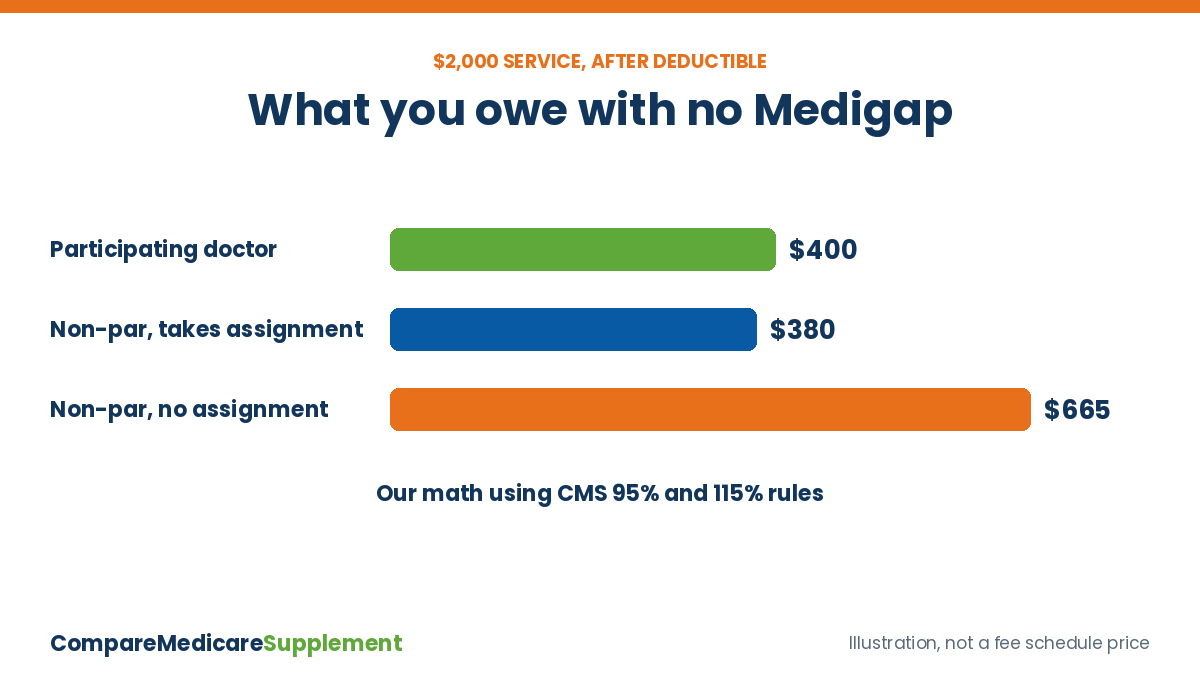
Your bill depends on which of three groups your provider belongs to. KFF reports that in 2022, 98% of physicians and practitioners billing Medicare were participating providers.
| Provider type | What Medicare pays them | What they can bill you |
|---|---|---|
| Participating (accepts assignment on all claims) | The full Medicare-approved amount | Your deductible and 20% coinsurance only |
| Non-participating, takes assignment on this claim | 95% of the participating amount | Deductible and 20% of the lower amount |
| Non-participating, does not take assignment | 95% of the participating amount | Coinsurance plus an excess charge up to 15% more |
| Opted out of Medicare | Nothing | Any amount in a private contract you sign |
Sources: KFF, How Many Physicians Have Opted Out of the Medicare Program? (Jan. 2025); CMS.
Ask the right question: Do you take Medicare is not the same as Do you accept Medicare assignment. Only a yes to the second means no excess charge.
Compare Medicare Supplement Plans
Call a Licensed Agent Now
Compare 2027 Plan G, Plan N and more from several insurance companies in one call.
No obligation to enroll
Our Math: How the 15% Limiting Charge Adds Up
The excess charge is not simply 15% of the usual price. Medicare first approves 95% of its normal amount for a non-participating provider, then lets that provider bill up to 115% of the reduced amount. The cap works out to 109.25% of what a participating doctor gets.
| Participating approved amount | Non-participating approved (95%) | Limiting charge (115%) | Excess charge |
|---|---|---|---|
| $200 | $190.00 | $218.50 | $28.50 |
| $1,000 | $950.00 | $1,092.50 | $142.50 |
| $5,000 | $4,750.00 | $5,462.50 | $712.50 |
Our math using CMS’s 95% and 115% rules. Example amounts are illustrations, not actual fee schedule prices.
On the $200 example, Medicare pays 80% of $190, or $152. You owe the remaining $66.50: $38 of coinsurance plus the $28.50 excess charge. At a participating doctor you would owe $40 for the same service.
Which Medicare Supplement Plans Pay Excess Charges
| Plan | Pays excess charges? | Who can buy it |
|---|---|---|
| Plan G | Yes, 100% | Anyone eligible |
| High-deductible Plan G | Yes, after the $3,050 deductible in 2027 | Anyone eligible |
| Plan F and high-deductible F | Yes | Eligible for Medicare before 1/1/2020 |
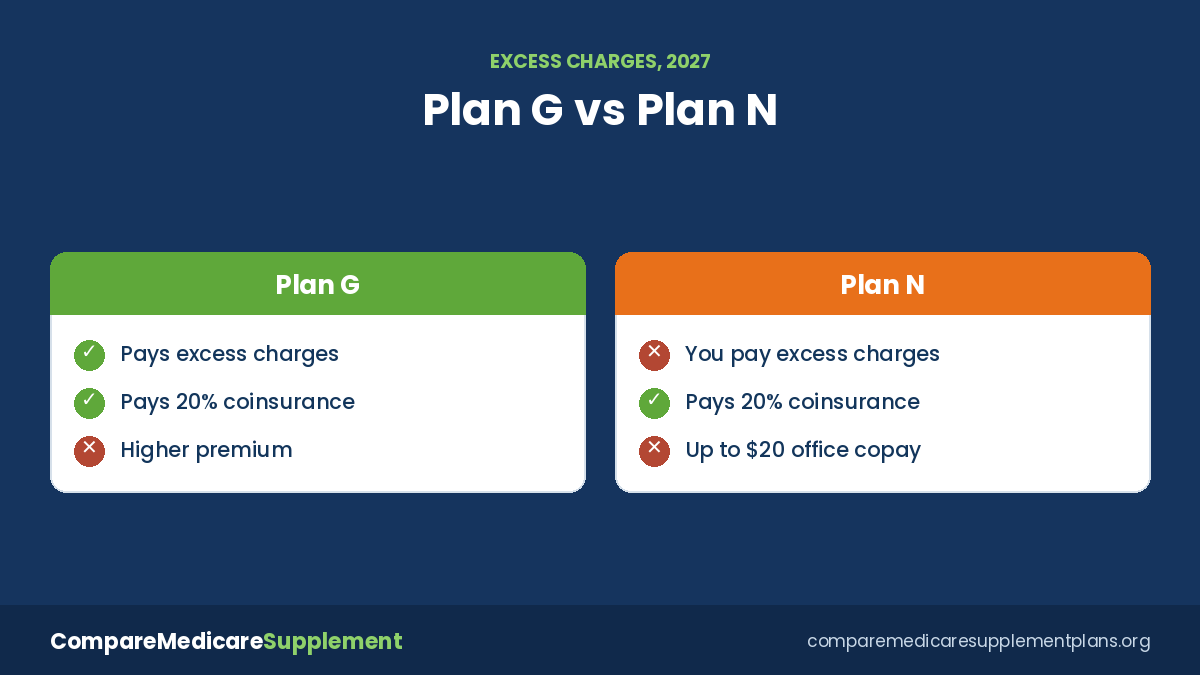
| Plan N | No | Anyone eligible |
| Plans A, B, C, D, K, L, M | No | Varies by plan |
Source: CMS standardized Medigap benefits.
Using the $200 example, here is what you would pay after meeting the Part B deductible, $292 for 2027.
Plan G: $0. Plan G pays the $38 coinsurance and the $28.50 excess charge.
Plan N: up to $48.50. Plan N pays the coinsurance, but you owe the $28.50 excess charge plus a copay of up to $20 for an office visit.
Plan K: $47.50. Plan K pays half the coinsurance in 2027, leaving $19, plus the full $28.50 excess charge.
Plan N’s lower premium only works if your doctors accept assignment. Our Plan G vs Plan N comparison covers the premium side of the trade-off.
States That Ban or Limit Excess Charges
Eight states are commonly listed as having Medicare overcharge laws: Connecticut, Massachusetts, Minnesota, New York, Ohio, Pennsylvania, Rhode Island and Vermont. The details differ, and some are limits rather than full bans.
New York. Doctors can charge only up to 5% over the Medicare-approved amount for most care, instead of 15%.
Minnesota. Excess charges are barred on most services, but ambulance services and medical equipment are exceptions.
Massachusetts. Doctors who take Medicare cannot bill excess charges. See our Massachusetts Medicare Supplement guide.
Ohio. Excess charges are treated as balance billing, which Ohio prohibits.
Border warning: These laws protect you for care in that state. A resident of a ban state who sees a non-participating doctor in a state without a ban can still receive an excess charge.

Gaps Most Guides Miss
Medical equipment has no 15% cap. CMS says there is no limit on what a non-participating supplier can charge for durable medical equipment. Use suppliers that accept assignment.
Opted-out doctors are a different problem. KFF counted 12,244 non-pediatric physicians who had opted out of Medicare as of November 2024, with psychiatry the highest rate at 8.1%. Medicare pays nothing for their services, so a Medicare Supplement plan pays nothing either.
You may pay up front. When a provider does not accept assignment, you may be asked to pay the full amount at the visit and wait for Medicare to reimburse its share.
QMB protects some people fully. People in the Qualified Medicare Beneficiary program cannot be billed for Medicare cost sharing by providers.
If you see a specialist who opted out, ask for the private contract in writing before treatment, since neither Medicare nor your plan will pay any part of it.
How to Avoid Excess Charges in 2027
Ask about assignment before booking. Ask the office whether the provider accepts Medicare assignment for all claims, not just whether it takes Medicare.
Check Medicare’s Care Compare tool. Physician profiles on Medicare.gov show whether a clinician accepts assignment.
Ask suppliers too. For wheelchairs, CPAP machines and other equipment, choose a supplier that accepts assignment.
Match the plan to your doctors. If a specialist you rely on does not accept assignment, Plan G removes the excess charge risk. Plan F holders already have it covered; see our Plan F guide.
Read your Medicare Summary Notice. Providers are required to refund any amount billed above the limiting charge. If it does not, contact Medicare and list the claim from your summary notice.
Bottom Line
Part B excess charges in 2027 are rare but real: up to 15% above Medicare’s reduced non-participating amount, which can mean $712.50 on a $5,000 service. Plan G is the plan open to new enrollees that pays them, and in eight states local laws remove or shrink the charge.
See 2027 Plan G prices that cover excess charges in your ZIP code
Part B Excess Charges 2027 — Frequently Asked Questions
➤ How much can a doctor charge above Medicare in 2027?
A non-participating provider who does not accept assignment can charge up to 15% above Medicare’s non-participating approved amount for most services. Because that amount is already 5% lower, the cap equals 109.25% of what a participating doctor receives.
➤ Does Plan N cover Part B excess charges?
No. Plan N pays the 20% coinsurance after the Part B deductible, but you owe any excess charge plus copays of up to $20 for some office visits and up to $50 for ER visits that don’t lead to admission.
➤ Which Medicare Supplement plans pay excess charges?
Plan G, high-deductible Plan G after its deductible, and Plan F and high-deductible Plan F for people eligible before 2020. No other standardized letter pays them.
➤ Which states don’t allow Part B excess charges?
Connecticut, Massachusetts, Minnesota, New York, Ohio, Pennsylvania, Rhode Island and Vermont are commonly listed. Rules vary: New York allows up to 5% for most care, and Minnesota exempts ambulance and medical equipment.
➤ How common are excess charges?
Not very. KFF reports that 98% of physicians and practitioners billing Medicare in 2022 were participating providers who accept assignment on all claims.
➤ Is there a limit on excess charges for medical equipment?
No. CMS says non-participating suppliers of durable medical equipment have no limit on what they can charge, so choose a supplier that accepts assignment.
➤ Will my Medigap plan pay a doctor who opted out of Medicare?
No. Opted-out providers bill you under a private contract, Medicare pays nothing, and Medicare Supplement plans only pay their share of Medicare-covered claims.
➤ What should I do if I’m billed more than the limiting charge?
Compare the bill with your Medicare Summary Notice. Charges above the limiting amount must be refunded by the provider; contact Medicare if the office does not correct it.
Compare Medicare Supplement Plans
Call a Licensed Agent Now
Compare 2027 Plan G, Plan N and more from several insurance companies in one call.
No obligation to enroll